I am actually a reformist. In fact, I came from a family that supported “reform” from a young age. I remember listening to my parents complain about the fate of the former Deputy Prime Minister and Minister of Finance, whom the 4th Prime Minister sacked in the late 1990s. My mother even sent me a letter when I was studying in Japan, sharing her concerns over me writing about my support towards the establishment. She knew that I was not only a member of Kelab UMNO Jepun, the Malay Party’s overseas political branch, but also an exco member of the Tohoku area. I also wrote many articles condemning the ungratefulness of many rioters and reformist street protestors, which I could see through a different lens as a student sitting outside the ring.
But since 2007, I have started to realign my position. I started to realize something was not right. I could not see it yet. So, I became a little more ‘anti-establishment’, quietly in my heart. Slowly, I realized that the real ongoing issues that became the heart of Malaysia’s problem are because there are “forces out there” who are trying to weaken the establishment that the Malays and Muslims are leading in Malaysia. Some say it was the work of George Soros, and some even link it to communism or socialism.
Either way, Malaysia is weakened because UMNO is attacked through corruption and scams; or when they are not in power, those who wield the staff of power shall be the subject of those who want to see the fall of Malay supremacy and Islam. This is my fear, and it is becoming clearer by the day.
Yet, the current Prime Minister recently declared that those who oppose his vision of reformasi are not part of his collective vision to fight corruption and abuse of power. It is hard not to recall the irony.
When Barisan Nasional (BN) introduced the concept of “Transformation” years ago, a concept of genuine efforts to reform from within the government, somehow the opposition ridiculed it. They branded the effort as useless because the crook wanted to correct the sinking ship, or as the Malay proverb says: “seperti tupai membaiki labu”. Today, those self-proclaimed “reformists” hold on to power, operating on the premise that they alone possess the moral authority to fix this country, and now they demand everyone to fall in line. Either you are a “reformist,” or you are an outcast, almost equal to the corruptors who have been defeated and ridiculed.
We must be pragmatic. The world is round, and we are not immortals. The PMX is in his late 70s, championing an anti-corruption crusade to clean up systemic messes finally brought to light. But look closely at the establishment; the system itself remains largely unchanged. The government is using the same system and structure designed by the founding fathers of this country. There is nothing wrong about that, actually.
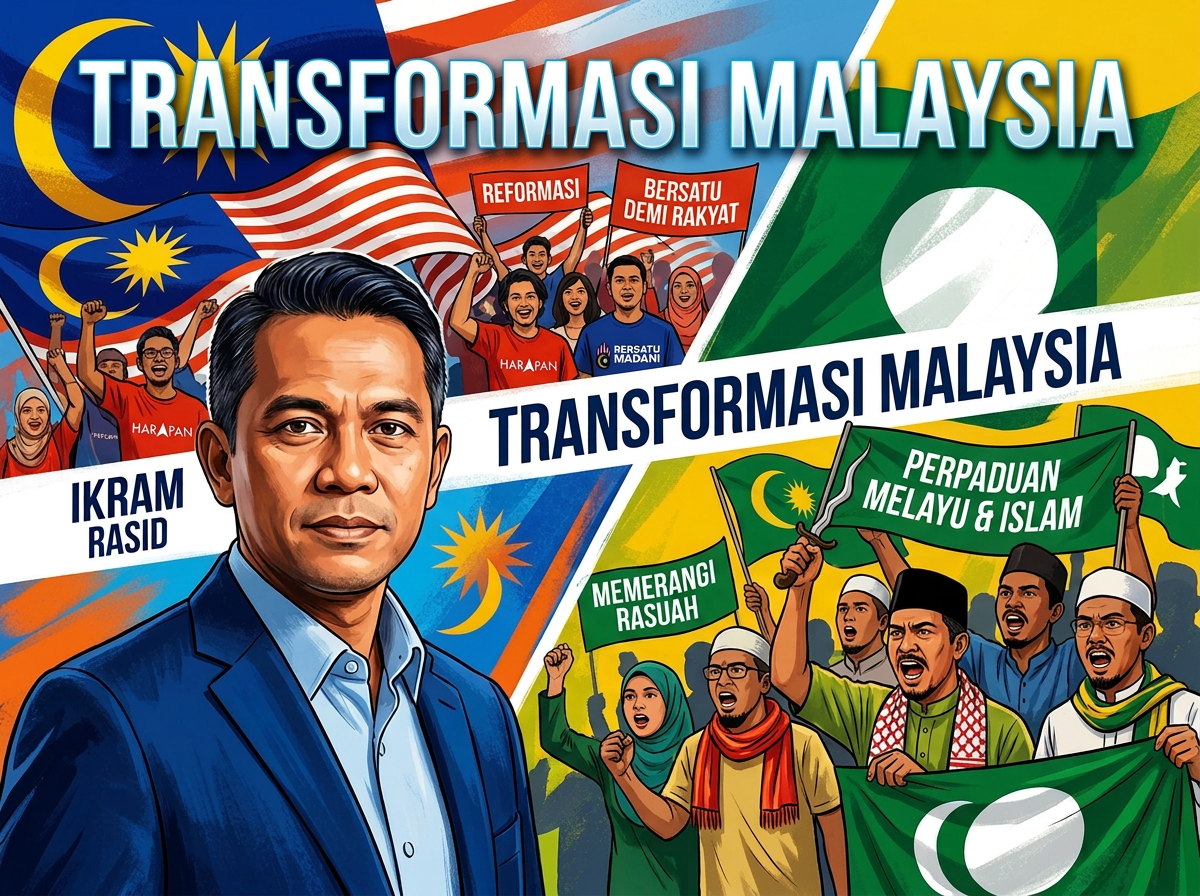
Looking at all this, we know the only true structural shift they are aggressively pushing is “political” in nature. The idea of reform is actually about the systematic dismantling of Malay and Muslim-led governance by parties like UMNO, to be replaced by the multiracial framework of PKR or DAP, now calling themselves Pakatan Harapan (PH).
This is why the persistent mantra at every political ceramah is the rejection of “narrow, race-and-religion-based politics.” They keep reminding the people of Malaysia that championing the cause of Malays or Islam is narrow, racist, and extreme. Yet the idea is to ensure voters feel they need to reject UMNO and even PAS, included.
Although UMNO has long governed through the multiracial BN coalition, consisting mainly of UMNO, MCA, and MIC, the new narrative seeks to divorce future generations from the bedrock of Malaysian politics: the understanding that Malays must lead. They want us to believe that only a multiracial party is equipped for the future. But will Malaysians truly accept a DAP Prime Minister by 2050? Let’s say, even if the Malay-Muslim leaders from UMNO of tomorrow are proven to be the most capable, clean, fair, and just?
Now, after 69 years of independence, Malaysia has progressed immensely. We have evolved from a post-independence society with low literacy into a highly educated electorate capable of deciding its own destiny. It is no longer easy to cheat Malaysians, no matter how much political actors may froth at the mouth trying to deceive them.
The reformist agenda is not Pakatan Harapan’s exclusive property. We must remember history that the 1998 reformasi movement was born from the Asian Financial Crisis. As Finance Minister, Anwar Ibrahim was seen to dismantle the Malay-dominated economic patronage structure to appease the IMF and World Bank’s demands for austerity.
Tun Dr. Mahathir saw this as “a threat” to UMNO’s efforts to secure more businesses and economic returns for bumiputeras, or Malays, on their own lands. As a result, he sacked his deputy because Tun Mahathir understood his amanah, his sacred trust, which is about protecting the Malays, Islam, and the nation from foreign economic subjugation. He did the unthinkable: he rejected the IMF and pegged the Ringgit to the USD at RM3.80. That bold move was the ultimate execution of the amanah, defending our sovereignty and dignity when the so-called reformists would have surrendered our economy to foreign powers.
Following that, the reformist narrative was weaponized. Under the guise of fighting “injustice,” activists branded a leader once revered as a mentor as a Mahazalim (Great Tyrant). The definition of “reform” became vague, boiling down to a singular goal: defeating UMNO and BN.
However, Anwar’s followers and loyal supporters argued that Mahathir, “the Mahazalim,” wanted to protect his cronies and family. They used this narrative to destroy the image of the Father of Modernization of Malaysia and eventually forced him to step down, which brought Malaysia into a short-term stable government under Tun Abdullah Ahmad Badawi (Pak Lah) as Prime Minister of Malaysia, with the concept of Islam Hadhari. As we could see, the moment UMNO started to use the concept that is not aligned with these unknown forces, such as the term of Islam Hadhari, despite that it was not extreme at all, then he was brought down for whatever reason that can be.
In 2018, they achieved exactly that. Yet the core power structure endured, thanks to the genius of Tun Dr. Mahathir, who took charge when he saw that the threat was imminent. Then came GE15 in 2022. Pakatan Harapan won the most seats (82), while BN suffered its worst defeat (30). And yet, divine providence intervened. PH could only form a government by bringing BN into the fold. The party that they hated so much, and the Malay supremacy that never faded from the political spectrum of Malaysia. This was a powerful, undeniable signal from Allah the Almighty that you may pursue reform as vigorously as you wish. Still, you cannot erase the sanctity of this nation’s foundation. Ultimate power must reside in the hands of capable, clean Malay leaders from Malay- and Muslim-based parties. Without this anchor, this country will lose its direction and the blessings of Allah the Almighty.
Perhaps PMX is the only exception we can accept to lead from outside a Malay-centric party, precisely because he carries UMNO DNA and has spent decades championing his brand of reform. We allow this chapter to unfold, and let the world know that, without the support of the majority of Malays, the reform agenda will never materialize. So, what is next after PMX? The leadership must return to its rightful stewards: UMNO from the BN.
This is not racism. This is the amanah inherited from our forefathers since the days of the Malacca and Kedah Sultanates, or even earlier. It is our duty to ensure that Malaysia, and all Malay-Bumiputera lands, are defended and led by the cleanest, most capable individuals who prioritize this legacy. When we fail to uphold this trust, we lose our integrity or amanah. We must stand fiercely against any force that seeks to dismantle this sacred structure, fighting for our right with every ounce of resolve we possess.
Leave a Reply