The world is now at a crucial turning point. In December 2024, Forbes featured an article with the title “World War III Has Already Begun—And Businesses Need To Take Note”. I could already detect this trend as early as February 2014, since that year represented a significant shift in global geopolitics. Nevertheless, most leaders either disregard it or are unwilling to face this emerging threat, which leaves the world open to the possibility of history being repeated.
Malaysia is situated at one of the world’s most strategic crossroads: the Strait of Malacca. For thousands of years, this narrow sea route has been the center around which empires, wealth, and mysteries have developed. Whether in the age of spices and gold or the period of religious crusades, control of the Strait of Malacca has always meant influencing the course of global history.
Power has always been acquired either by means of colonization or through quiet influence, yet control of the area has never been permanent. Although empires have come and gone, the Malays and the native populations have always stayed in the region since civilization began. In 1991, when the ‘Perak Man’ was found in the Lenggong Valley in Perak, solid evidence was obtained. Dating from about 11,000 years ago, he is the oldest and most complete human skeleton that has ever been discovered in Malaysia and all of Southeast Asia and thus serves as a silent witness to humanity’s early presence in the area.
The Perak Man may have been the region’s first true master. And appropriately, the word ‘Perak’ means ‘silver’, a name that suggests the area’s natural wealth and lasting appeal. So, when I talk about the vital importance of Malaysia and Southeast Asia to the world’s future, I base my views on this significant and often neglected history that still influences global events.
Although Malaysia may not always be a prominent figure in world history and is often relegated to the background by leading historians, its importance is essential and enduring—much like the heart and brain in a living organism. Take Taman Negara: it is not only a source of national pride for Malaysia but also one of the world’s oldest tropical rainforests, having been around for 130 to 140 million years. This ancient forest existed before the Ice Age and outlasted the catastrophes that destroyed other ecosystems. In fact, it is a living remnant from the age of the dinosaurs, gently influencing the planet’s ecological heritage.
Some even speculate—based on religious tradition—that ancient tropical forests like these might have been the cradle of human renewal after the biblical flood and that they existed long before people settled in the area. These rainforests are not simply wild lands; they contain food, timber, wild fruits, animals to hunt, and natural shelters in caves. Humans have always been capable of adapting and of moving around; those who migrated may have gone on to settle in places such as Mesopotamia or Europe, but the tropical forests stayed behind as stores of life and survival.
Beyond myth and legend, Malaysia and the Malay Archipelago have been a focal point in human evolution, shaped by busy sea routes, cosmopolitan trading ports, and continual changes in geopolitical conditions. The region’s abundance of timber, precious metals, key trade routes, spices, and human ingenuity has fostered a sophisticated, adaptable population. The tendency among Malays and Southeast Asians to thrive through moderation, hospitality, and adaptability has been shaped over centuries by constant exchange and the need to survive in changing eras. They thrived even more after Islam arrived in the region.
Islam first reached the shores of Barus in Sumatera while Prophet Muhammad p.b.u.h. was still alive, planting seeds which later grew and spread all over the area over a period of more than 1,450 years. This early contact was not coincidental—historical records show that in 628 CE, during the seventh year after the Hijra, the Prophet sent envoys with diplomatic letters to the great powers of the world, including Emperor Heraclius of Byzantium, Emperor Khosrau II of the Sassanid Persian Empire, the Negus of Abyssinia, Muqawqis of Egypt (who was the Roman governor), and the rulers of the Levant, Oman, Bahrain, and Yemen. The spread of Islam strengthened the Malays’ resilience by giving them a strong spiritual belief and a sense of unity that enabled them to withstand the challenges of imperial and colonial invasions for centuries after the Prophet’s death. This deep-rooted faith thus became a fundamental element in the region’s cultural endurance and helped to shape its destiny through periods of adversity and change.
When Islam extended its influence across the Malay archipelago, Middle Eastern and Western Asian traders had already been using maritime trade routes which reached maritime Southeast Asia, covering places such as Aceh, Java, and Malacca. The various kingdoms located there were important stages for traders who were travelling to more eastern destinations like China, Taiwan, Korea, and Japan.
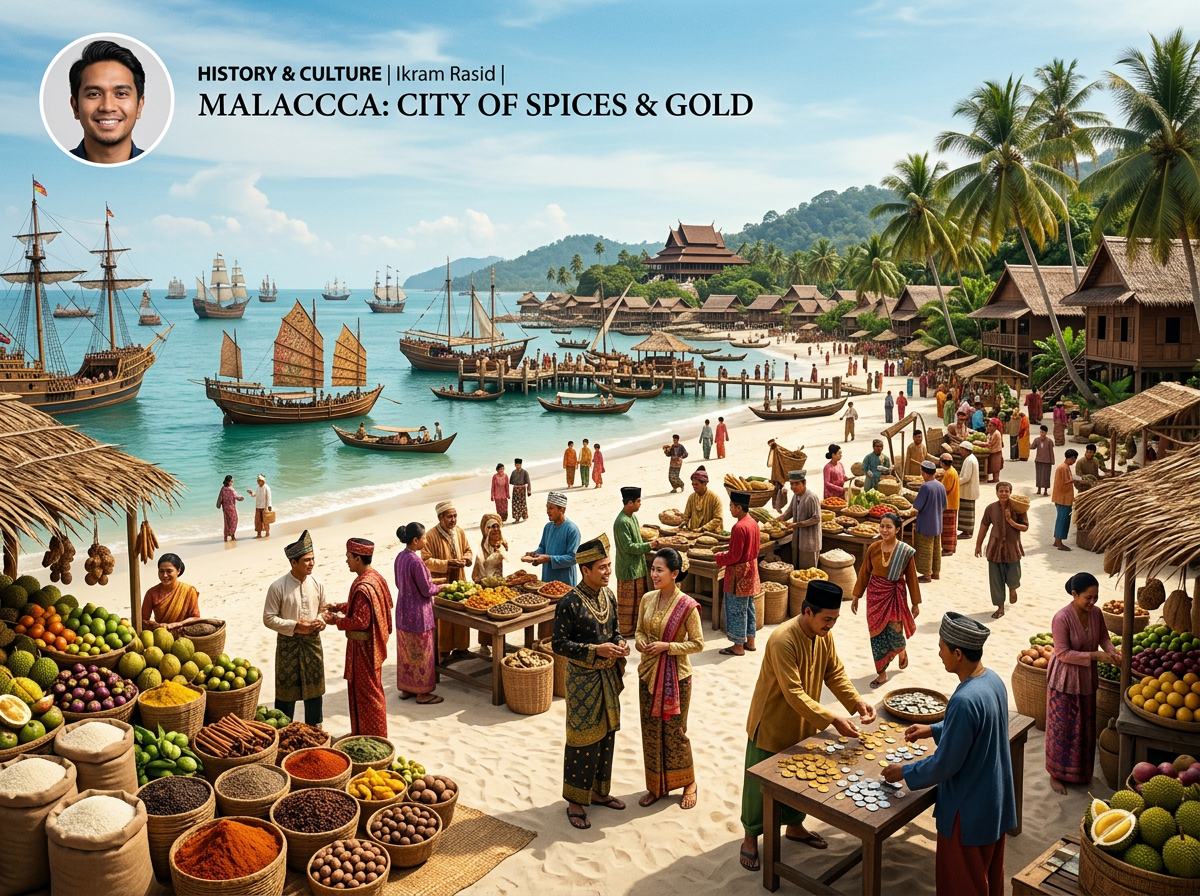
At that time, those areas (Aceh, Java, and Malacca) were among the richest in the world. The kings and queens of the Malay Kingdoms gave gold coins to all their citizens as though the coins had no value. This is probably true because spices were the most valuable things during that period, and they didn’t need gold to live in luxury. Princes and princesses would throw spice seeds onto the ground, and the seeds would naturally grow. In that era, accumulating spice wealth was like saving up chips and luxury supercars today. Spices were not simply seasonings used in the kitchen to improve the taste of Asian food; they were high-stakes, high-margin luxury commodities that enabled and also brought down global superpowers.
Consequently, the various kingdoms in the archipelago did not bother to defend their territories since the neighbouring countries also had a plentiful supply of resources and a pleasant climate throughout the year; at the same time, the states to the north—namely China, the Middle East, Persia, Egypt, and Europe—were frequently at war and had to prepare for severe weather and make do with limited resources.
China was one of the first countries to recognize the valuable resources in the Malay archipelago and was considered the most advanced civilization in the world at the time. Persia and India were also highly developed and wanted to safeguard their trading interests along the islands’ trade routes. At the time, Persian and Arab geographers referred to the Malay archipelago as the “Islands of Gold and Fragrance” because of the large amount of precious metals there and the wild trees, flowers, and woods, which they used as fragrant gifts for rich officials and kings. Al-Masudi, Ibn Khurdadhbih, and later Ibn Battuta often described Southeast Asia using expressions similar to those of mythical gardens or divine abundance. They regarded the region as heaven on earth because the islands produced camphor (Kapur Barus), sandalwood, cloves, and nutmeg, which literally perfumed the sea air before ships even reached land. Arab accounts frequently portrayed parts of Indonesia and Malaysia as areas where “the earth breathes sweet scents” or as lands of mythical wonder.
This applied equally to other Asian civilizations. In the case of ancient Chinese civilization, the Malay Archipelago and maritime Southeast Asia were seen through a particular conceptual framework called the Nanyang or the “South Seas”. For Chinese merchants, admirals, botanists and the imperial courts, the Malay Archipelago was considered a rich storehouse of treasures. Even before the arrival of European ships, Chinese records from as far back as the Han Dynasty and which increased considerably during the Tang, Song, and Ming dynasties stated that the area was the only source of high-value commodities that could not be grown or obtained in China. Since the Malay islands were located at the meeting point of the seas between China and the Indian Ocean, Chinese merchants regarded them as a gateway market where goods from all over the world came together.
It was reasonable for the powerful kingdoms at that time to pay tribute to chieftains or kings in the Malay archipelago since these rulers gave them safe passage and protected the goods which the kingdoms traded between the seas. According to the traditional Chinese way of thinking, or Sinocentrism, the imperial court looked at foreign countries through the lens of a hierarchical tribute system; the kings and queens of Sumatra, Java and the Malay Peninsula were frequently listed as independent states which could send envoys to present their local products to the Chinese emperors, and in return the emperor gave them gifts, entered into military alliances and issued official seals of recognition.
During the Song and Yuan dynasties, and reaching its height with Admiral Zheng He’s expeditions in the Ming Dynasty (the 15th century), the Chinese attitude towards the Malay archipelago changed from one of vague “mythology” to one based on practical navigation. Highly accurate maritime compass charts and pilot books (for example Mao Kun’s maps) showed in detail every reef, island, and sultanate in the Malay Archipelago, considering the area no longer as a mythical fairy land but as a important, well-organized maritime route which needed careful diplomatic upkeep.
However, after the world entered the period of imperialism and colonialism in the 18th century the worldviews of both China and India towards the Malay archipelago changed considerably. The imperialists regarded the area as one that was disputed, rich in resources and “easy to exploit”. The fact that the Malay kingdoms were weak because they had placed too much reliance on military alliances with Chinese and Ottoman powers made them vulnerable to attack by the colonialists. Since the colonial powers wanted to obtain more resources and territorial expansion and even though they knew the region was very distant from their homelands, they continued to make great efforts not only in sending naval forces, convoys and diplomats to the area but also in remaining there as long as possible, even though they suffered many losses on the way because of the rough seas and the conditions.
The desire of kingdoms and dynasties throughout the world at the time to achieve absolute power and gain hegemony also led them to devote resources, particularly during the period of imperialism. This became one of the main driving forces behind the “Age of Discovery” (though the term “discovery” applied only to Europeans). European explorers, captains, and royal agents who reached the Malay Archipelago between the 17th and 18th centuries returned with accounts of incredible wealth that prompted royal investments amounting to billions of dollars (of today’s value) and sparked intense geopolitical competition.
Many historical accounts have portrayed the Malay Archipelago as a region of great richness, wealth, abundance, and happiness. For instance, after the Portuguese conquered the large trading port of Malacca (although it was on the Malay Peninsula and they were never able to take the entire Malay Kingdom) in 1511, a Portuguese captain named Francisco Serrão moved further east into the interior of the archipelago, which was known as the Spice Islands. He discovered islands where nutmeg and cloves were grown exclusively, places so rich in wealth that a single cargo hold could yield profits of thousands of percent. Serrão then established himself on the island of Ternate and began writing enthusiastic, very detailed letters to his close friend in Europe, Ferdinand Magellan. He described the islands as a hidden paradise containing unimaginable riches, more valuable than those the Portuguese had obtained in India.
Magellan then used Serrão’s intelligence reports to suggest a bold plan to the King of Spain: “fund an expedition to reach these islands by taking a western route.” The King of Spain, Charles I, was so impressed by the idea that he decided to finance Magellan’s famous circumnavigation in order to claim the Malay Archipelago for Spain, where he later found what is now known as the Philippines.
When the survivors of Magellan’s expedition finally returned to Europe in 1522, despite losing most of their ships and men during the dangerous voyage, they brought the one surviving ship, the Victoria, loaded with cloves from the Maluku Islands, and created a great deal of excitement. Antonio Pigafetta, who recorded what happened, wrote a lively account for the King of Spain about the rich landscapes of the Malay Archipelago, the kindness shown to them by its sultans, and the trees loaded with spices that grew wild like ordinary brush. The profit from one cart of spices was enough not only to cover the full cost of the disastrous expedition involving multiple ships, but also to leave a huge surplus, showing European monarchs that return trips to Nusantara were the most profitable venture on Earth.
The historical records show that the Malays were originally the richest race in the world; they were not only the richest but also the happiest and most friendly to foreigners. Their food was delicious and full of flavour, spices, and freshness, as well as clean and healthy, and they ate with their hands bare, not because they were uncivilised, but since they were so clean that they could wash their whole bodies as much as they wanted every day, owing to the fact that they had a plentiful supply of clean, fresh water from rivers, lakes, wells, and waterfalls.
The Malays wear simple clothes, but they are carefully designed with golden strings and threads (known as Songket), and both royalty and common people wear cotton and silk. Because they are so hardworking and inventive, they have produced colorful garments using natural dyes derived from edible oils, which are now generally referred to as Batiks. Owing to the availability of wood and their access to all kinds of wild resources, they have developed the ability to build houses out of wood that will never rot or decay. Cengal (scientific name Neobalanocarpus heimii, often spelled chengal) is highly regarded by traditional Malay master shipbuilders as the best, top-grade wood for building sea-going vessels in the Malay Archipelago.
It would be unwise for any civilization that enjoys the archipelago’s great supply of spices, water, wood, and valuable metals to pretend that it lacked such resources and therefore imitate societies which have developed in more severe climates. The Malays did not have to build houses from stone, as they needed clean air, where comfortable breezes flow throughout the day. It is also difficult to understand why someone should leave a paradise to live through cold winters or search for water during scorching desert summers—particularly since oil and gas had not yet made it possible to provide heat and light in distant cities and villages.
It is true that where there is an abundance of fuel resources, humanity can more easily cope with harsh conditions. Should the world fall into chaos, and even a small amount of oil or gas became as essential to survival as clean water, then Southeast Asia would have the power to decide whether the world survives. Picture a cold winter without gas and heating; the only places that could be considered paradise would be the tropical regions, linked by sea routes for transporting goods and wealth. If the world had to go back to a nomadic lifestyle and revert to the medieval period, it would not only need wood and clean water, but also spices to keep food fresh and preserved.
That is why Malaysia’s survival (and that of the entire Nusantara) and its emergence as a more powerful nation on this planet will become all the more important. Although many have come and gone, few appreciate the significance of its survival, particularly for the future geopolitics of the world. In order to survive, Malaysia and Nusantara will need strong Malay communities and politics. It is therefore vital for the future of this world—at least for the next few hundred years—that Malay dominance be restored. Let the Malays lead the region, and let the world ensure its long-term survival by protecting the region as a source of future wealth in natural resources and its abundant wild resources. Let it become a paradise on earth, as long as possible, in order to keep humanity alive as long as possible, if not forever.
You see, all over the world people spend their entire lives trying to reach the top of the wealth ladder—pursuing the idea of living like kings and queens in a place where simple clothes are sufficient, where the fresh blue waters attract you, where good food is plentiful, where tropical fruits are within easy reach, and where the sun shines continuously over white beaches and coconut trees that sway. For many, this is the ideal paradise.
Nevertheless, for thousands of years the Malay people have lived in this paradise. Humble and rooted, they have never let arrogance define them, and their legacy has been one of quiet stewardship, living in harmony with the land’s bounty. It may be time to acknowledge that the Malays are the true stewards of their own paradise and that fate and the grace of Allah, the One True God, have entrusted it to them.
Leave a Reply