I do not consider myself to be a racist. I just have a deep affection for my own race, the Malays. I am by no means a racist.
“Racism” happens only when a dominant ethnic group systematically prevents others from enjoying basic human rights, for example, by stopping them from sending their children to school or from using public spaces.
In Malaysia, affirming the importance of Malay heritage should not be mistaken for racism. The country’s name and the constitutional recognition of Malay identity underscore a historical and legal foundation rooted in inclusivity, not exclusion. Malaysia expressly rejects racism and does not pursue or enforce racist policies. When race-based initiatives are introduced, such as using Bahasa Melayu as Malaysia’s national language or implementing the New Economic Policy (NEP), these are best understood as acts of nationalism or expressions of cultural pride, intended to uplift communities that have historically faced disadvantages in areas like the economy and education.
In fact, other countries do quite the same. China ensures a common linguistic identity, the Mandarin language, among its citizens, just as Indonesia establishes basic cultural frameworks for its population through a Pancasila framework. All sovereign states have the right to decide what they believe best preserves their true identity. That is not racist, but more about protecting the interests of one’s national identity.
Then who actually owns a country? As the owner of this country, who should determine Malaysia’s national identity?
According to commercial theory, individuals or corporations that legally buy property own those assets they purchase. However, these entities are only beneficiaries of the legal system, and not a sovereign state.
So who owns “the country” itself?
Some claim elected leaders have the responsibility to protect the “ownership of the country”, but in democratic systems, politicians “come and go.” Even in authoritarian regimes, human mortality means that, at some point, the responsibility for governing a country must pass to the next generation.
This shows that genuine “ownership of a nation” is closely linked to a people’s fundamental identity and basic principles, not just race, but rather a lasting “cultural identity and spirit.”
To illustrate this, let’s test the ownership “based on identity” concept by considering what happened to the Ford Motor Company. Henry Ford is no longer with us today, yet his descendants own the company and still hold strong voting rights that shape its future. The Ford’s brand has kept its traditional blue color and its original idea of offering affordable vehicles to consumers. As a nation’s identity, it should be just as resilient, unlike modern public corporations that readily give up their origins when foreign investors take control or when the company is listed publicly.
For a country, this fundamental principle usually begins with its name and national language. So, when a nation’s official language is Malay, and its name bears the word ‘Malay’, its historical and cultural ties are rooted in Malay identity; but if it presents a mixed identity by adopting foreign customs while using a different language, it risks cultural confusion. Even the United States of America faces the same risk, as it has to re-examine its fundamental culture: whether it has transformed from a European-colonized entity into an independent, free nation with a liberal society where it promotes freedom of expression and any of its citizens can become anyone they want to be, even if they choose Islam as their religion. It invites confusion if the majority of the population, say in 100 years, choose a totally different ideology or lifestyle than 200 years before.
Consider Saudi Arabia, an unmistakably Arab nation governed by the House of Saud, whose flag features the Islamic declaration of faith and green symbolizing Islam. Both its language and culture are distinctly Arabic. In contrast, Singapore exemplifies a nation with a blended cultural identity. The name “Singa,” meaning ‘Lion’ in Malay, highlights its historical roots, while its flag echoes its original cultural identity. Over time, as a historic trading port, Singapore has evolved into a vibrant hybrid society, seamlessly integrating diverse culinary, musical, and cultural influences from around the globe. This cultural mixture does not inherently lead to confusion, provided the nation remains anchored to the ideological principles upon which it was founded.
In Malaysia, the growing prominence of the campaign in favor of Jawi, the traditional Arabic script used to write Malay, reflects a desire to reconnect with cultural roots, the true identity of Malays in this region. The push to use Jawi is strongly aspirational, aiming to tie the Malay peoples to the region’s history, and it has been formally included in Islamic education over the years; Jawi is now highly visible in Malay heartlands such as Kelantan, Terengganu, Pahang, Kedah, and Perlis.
However, this is not limited to Malaysia. The Jawi script and traditional Islamic education are still practiced across the Nusantara, including Brunei, Indonesia, southern Thailand, and the Philippines. This cultural revival reflects a broader effort to preserve Malay political and cultural influence.
But why is there a growing desire to preserve this Malay and Islamic heritage?
It is actually based on historical observations. Throughout the region, the Malays have seen major changes. In Indonesia, the establishment of a unitary republic destroyed the old sovereign sultanates. In Singapore, political control of the ethnic Chinese appears to be entirely excluding Malay participation with any substantial influence and control on their own soil, almost permanently. In certain areas of Thailand, Cambodia, and the Philippines, past assimilation policies have caused minority groups to weaken their native identities. Regionally, they note neighboring countries with different systems of government, such as secular meritocracies where historical factors and post-colonial policies have altered indigenous peoples’ socioeconomic position. Worldwide, the ongoing difficulties faced by Muslims, especially in Palestine, have a strong impact on their worldview too.
As a result, concern about cultural loss has increased in Malaysia. Those who advocate a melting-pot approach to governance are seen by the right-wing, conservative groups as posing a direct threat to the historical Malay identity. This creates political tension between those advocating equal civic reforms and those determined to preserve Malay supremacy heritage.
Then we have to go back to the original question: who actually owns this country called Malaysia? Or perhaps, a better question is, “who can claim supremacy over this country called Malaysia?”
By constitutional arrangement, the Malay rulers hold a special position of sovereignty; the Yang di-Pertuan Agong functions as the Supreme Commander of the Armed Forces and as guardian of Islam, lands, and Malay custom. Although the monarchy operates within a constitutional system alongside an independent judiciary and legislature, its role as the nation’s custodian remains central to the nation’s structure.
Nevertheless, philosophical ownership goes beyond legal definitions or traditions. Malaysia is a society made up of many different racial groups. To establish genuine ownership, we must ask: how strongly are we ready to defend its sovereignty? Would anyone stand up and fight if a foreign power launched an invasion to take our strategic resources? Who would go beyond the miles to fight for an inch of its sovereign territory, by means of legal defense or militarily?
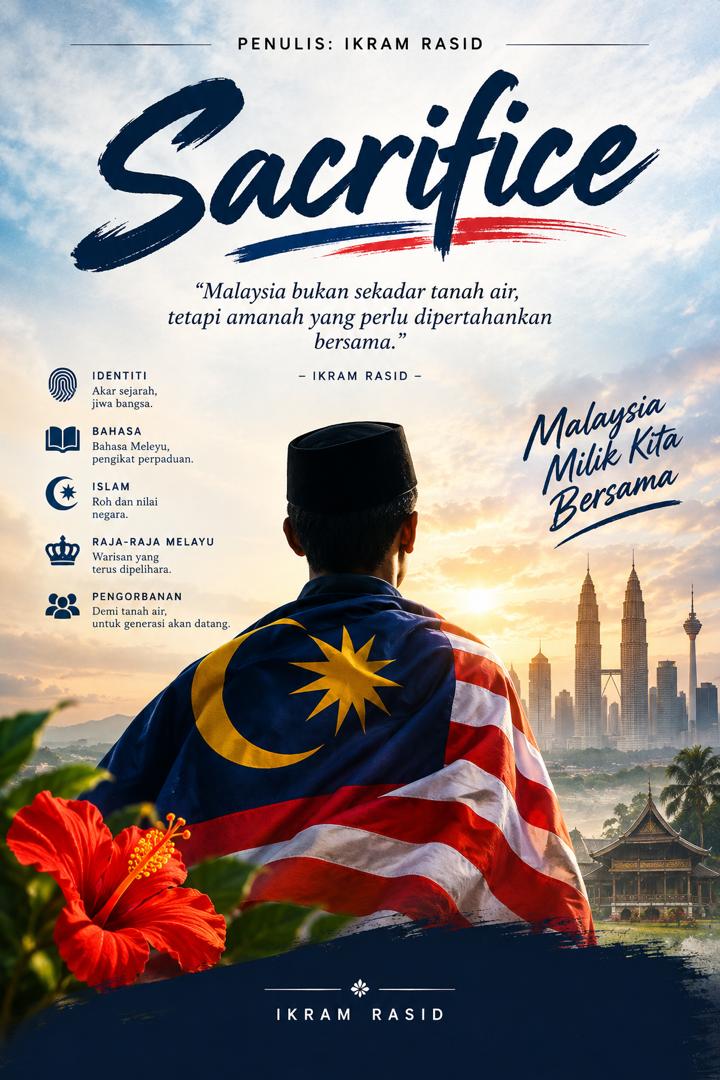
To answer the question of “who owns Malaysia” and as to who are “the genuine owners of Malaysia, together with the rest of Nusantara?”, we must first ask the question about the willingness to sacrifice in order to defend the soil and lands they were born in and its sovereignty. Only those willing to defend their own country’s sovereignty can claim ownership and supremacy in the country. Those who are not willing to do so are temporary beneficiaries or opportunists who seek to loot resources, just as colonialists did in former times.
The best indication of genuine ownership and ketuanan over this sovereign territory comes from the people who serve in the military and security forces. These are the individuals who are willing to defend their country at all costs. At the very least, those who are not in the military or security forces but are willing to finance the nation’s defense and are ready to give up everything for the country can also be considered the true citizens of this country, loyal and not the enemies from within. But the race that has the most contribution to the military, security forces, and all the efforts to defend this nation is the true owner and supreme master of this nation, unless they are criminals who are corrupt and disregard the laws of this country. The corrupt and criminals are also the enemies from within, and perhaps, worse.
Hence, on the basis of this definition, the Malays can be considered to be the tuan of Malaysia or the supreme race of this country, and so long as the military and security forces are not multiracial, the country will have to continue with its policies of Ketuanan Melayu, or Malay supremacy, until the non-Malays join the military forces in large numbers. Even so, the Supreme Commander of the military and security forces remains in the hands of the Yang Di-Pertuan Agong, the King of Malaysia, who is also the guardian of the Malays and Bumiputeras, including, directly or indirectly, the people and citizens of Malaysia.
And therefore, that is the context of Malaysia’s independence. Colonialists run and save themselves during the World War, or any war, for that matter. They do not love the soil they captured through imperialist means to plunder the resources. When conflict arises, they will simply flee for their own safety. Those who will stay are those who love their nation and identity. But as an independent nation, Malaysia can offer assistance or even seek assistance during trying times, especially if attacked by enemies. An alliance with other countries or sovereignties should not be seen as weakness or as letting other powers dominate our country. It is about strategic decisions to protect our sovereignty if that becomes necessary in the future.
So, if Malaysians really love this country called Malaysia, they must – without any excuses- join the security and military forces to defend the sovereignty of this beloved nation. As one true Bangsa Malaysia, I wish to see that not only do Malaysians of future generations fight side by side whenever any foreign elements are threatening the safety and sovereignty of this country, but also they will help each other, by means of resources, innovation, ideas, and even sacrifice everything, to protect this country that they love.
If they cannot do so, then they are mere passengers or immigrants who are temporarily staying here and not calling this place their ‘tanahair’ (or the motherland), together as one big family called “Bangsa Malaysia.”
Leave a Reply