In recent years, we have witnessed a powerful global trend: “economies that once depended on imports transforming themselves into export powerhouses.” The most striking example is China.
Decades ago, China imported almost everything and served as the world’s largest market for countless products. But after opening its economy, China has become an economic giant. Today, its market is largely self-sufficient, and it now dominates the entire Asian market with cheaper products of equal or even superior quality.
Let me put this in perspective with an analogy. Imagine a small, family-run shop that once relied on buying goods from a supermarket. Even though the family was large, they were poor and struggled to build their business. Over time, this family-run shop learned the trade, sharpened its buying power, and opened its own chain of stores, undercutting the supermarket with lower prices and flashier products. That’s what we see globally: countries like Malaysia, once a supermarket, are now squeezed by an economic giant that has mastered the system we helped them enter.
Malaysia consistently and vocally advocated for China’s integration into the global trading system throughout the 1990s, backing its bid to join the General Agreement on Tariffs and Trade (GATT) and later the World Trade Organization (WTO). I remember how Malaysia played a pivotal role in opening the world’s doors to China, overcoming decades of ideological rivalry and even past adversarial relations during the Communist Emergency. The 1989 peace agreement between Malaysia and the Malayan Communist Party, facilitated in Hat Yai, Thailand, marked a turning point in our bilateral relationship and the region’s economic future. Since then, Malaysia has helped China grow its economy, directly or indirectly, and it still does so today.
This journey of economic evolution is not unique to China. History shows us that economic alliances shift like tectonic plates. In the 1970s and 1980s, Japan’s rise seemed unstoppable. Its cars, electronics, and management styles set global benchmarks. There was panic in the US about the ‘Japanese invasion’ of their markets. Today, we barely hear about Japan as a threat. Instead, it’s China’s turn. The lesson? No economic dominance is ever permanent, and those who rest on past achievements risk being left behind.
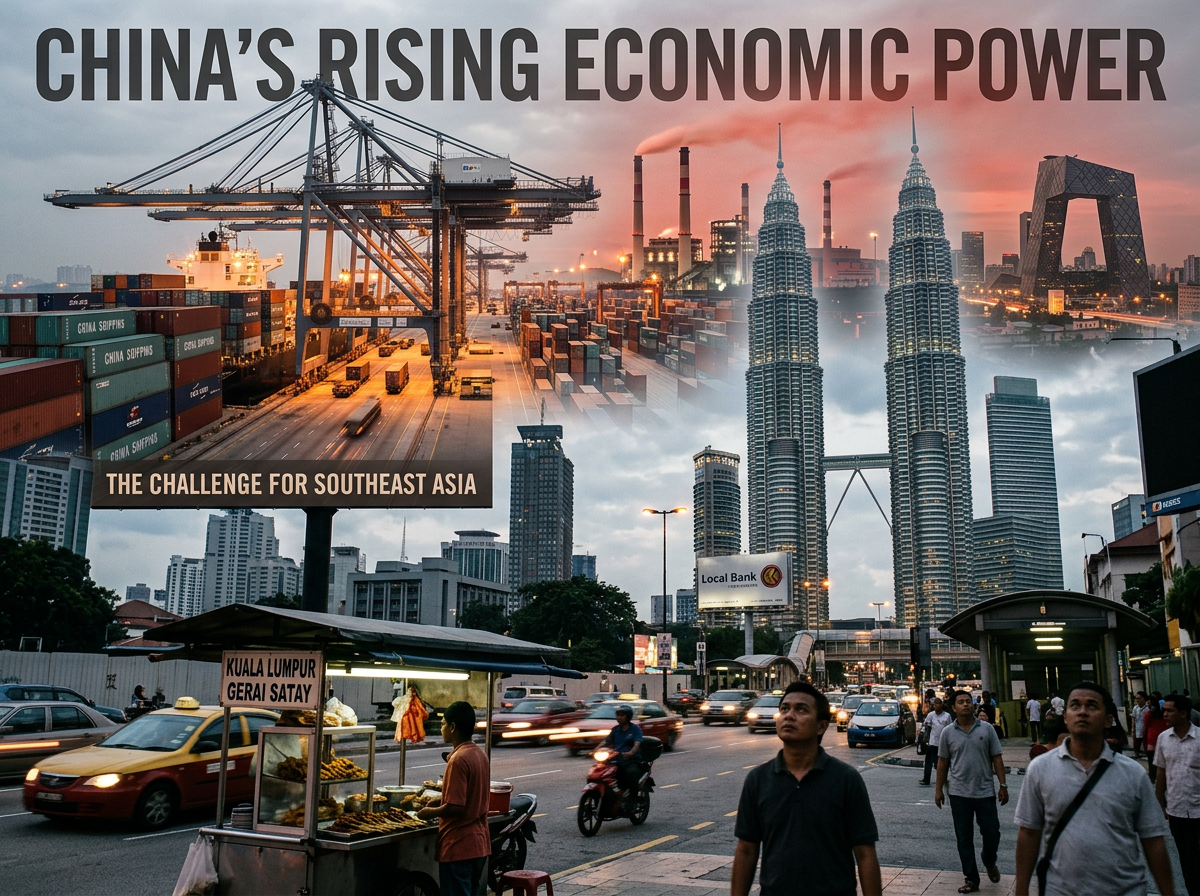
Against this backdrop, Malaysia’s current predicament becomes even clearer. Today, our manufacturing industry is in decline, threatened by China’s overwhelming economic power. Recently, the Minister of Trade announced that the government is reviewing products that contribute to Malaysia’s ballooning trade deficit with China, including goods we once proudly made ourselves (The Edge, October 13th, 2026). According to the Department of Statistics and the Ministry of Economy, Malaysia ran a RM101.5 billion trade surplus with the US in 2025 but a staggering RM163.4 billion trade deficit with China. If nothing changes, that deficit will only grow. Southeast Asia, with its nearly 800 million people, risks becoming nothing more than a goldmine for Chinese billionaires, draining wealth from our own shores.
It’s not just about numbers. It’s about the very lifeblood of our economy. Consider this: “Every ringgit that doesn’t circulate within Malaysia is a missed opportunity for our people.” When wealth flows out, it’s like water leaking from a cracked pot. Eventually, nothing is left for those who need it most. Our economic ‘pot’ is leaking faster than ever before, and if we don’t patch these cracks, the next generation will find it dry.
If you doubt the power of collective action, look elsewhere in Asia for inspiration. For a wake-up call, look at South Korea. After the Asian Financial Crisis of 1997, Koreans famously donated gold and personal valuables to help pay off the nation’s debt. They doubled down on local innovation, built world-beating companies like Samsung and Hyundai, and transformed their economy. It wasn’t magic! It was just pure determination, unity, and investment in their own people. That’s the spirit of true nationalism that Malaysia needs today, not just a mere “Malaysia Boleh!” slogan.
This brings us to a crucial question: how do countries not only rise, but stay on top? Building a booming economy from scratch is hard enough, but once a nation becomes wealthy, sustaining that prosperity is even harder, and it often comes at others’ expense. That is how China built its wealth, and now it is struggling to sustain the mammoth economic miracle it has created.
I am not exaggerating the scale of China’s success or the threat it poses to the world. China now poses an economic threat not only to the US, but to the entire world. By ‘threat,’ I don’t mean destruction in the traditional sense. I mean the quiet erosion of other nations’ wealth. As China’s fortunes rise, others must work even harder to hold their ground, or risk slipping into bankruptcy. Recent data from The Times of India shows China produces roughly one to two new billionaires every day. According to global rich lists, over 1,100 billionaires now call China home, a number that fluctuates with markets and the tech sector. While American capitalism boasts that ‘anyone can become a millionaire,’ China is quietly producing 100 new millionaires a day. That’s 36,500 a year! A small fraction given their population, but a staggering figure in absolute terms. For giant nations like China and India, job creation is the engine that keeps the economy alive, not creating billionaires, because it is just a byproduct of the core principle of economic growth.
The story of economic rise and fall isn’t new. The Roman Empire, flush with riches, eventually crumbled under complacency and overreliance on foreign labor. History repeats itself in different forms. Those who ignore the lessons are doomed to the same fate. Our challenge is to learn, adapt, and act before decline becomes irreversible.
But what about today’s realities? China’s explosive growth over the past two decades was anchored by relentless job creation, massive infrastructure, and industrial expansion. But after twenty years, China faces a new dilemma: “little remains to build, and little remains to manufacture domestically.” Economic growth has slowed, but the population keeps growing. Job creation, the fundamental engine of any economy, now faces limits. Without enough new jobs, especially amid population growth, any economy risks collapse.
Faced with these constraints, China looked outward. Recognizing its domestic limits, China launched the Belt and Road Initiative (BRI) in 2013, a massive push to create jobs and sustain growth by exporting its expertise and capital abroad. Under the BRI, China leverages its economic power to offer financial aid and loans for infrastructure projects, on the condition that recipient countries use Chinese banks and hire Chinese firms as primary contractors. These deals often bypass the strict environmental, governance, and political reforms Western lenders require. This strategy is the real medicine for China’s overextended economy: “exporting not just products, but jobs and opportunities for its own people.”
Here’s where the story gets complicated for countries like Malaysia. To use a medical metaphor, China’s BRI is like a patient with high blood pressure who decides to pump excess blood into others to relieve internal pressure. It’s a clever way to avoid internal collapse, but the transfusion comes with strings attached. The recipient becomes dependent on the donor’s continued goodwill. This is why we must be vigilant when accepting foreign investment: “The medicine can be as dangerous as the disease if we don’t read the label carefully.”
That’s why we must draw a line somewhere. Here’s the punch line: If you let someone else build your house, don’t be surprised if they decide everything, from the doors and locks to who gets to live there. Economic sovereignty cannot be outsourced. We must insist on meaningful local participation in every major project, or risk becoming mere spectators in our own country.
These issues play out in daily economic life. On the surface, appointing Chinese contractors seems like the perfect solution to these developing economies: “cost-effective, efficient, and less demanding than their Western counterparts.” But here’s the catch: “Chinese companies routinely bring their own engineers, managers, and skilled workers.” Because of language barriers, most of these staff speak only Mandarin, making local hiring secondary. Chinese firms justify this by citing strict timelines, safety requirements, and engineering standards. In practice, this means more jobs for Chinese citizens, and fewer for locals.
The downside for our future cannot be overstated. Imagine if our national football team, Harimau Malaya, always played with imported naturalized players while local players sat on the bench. It might win us a few matches, but where’s the pride, the growth, the development of homegrown talent? The same is true for our economy. Outsourcing progress may look good in the headlines, but it leaves future generations weaker and less prepared.
Technological progress threatens to accelerate this trend even further. For now, the only real barrier to China’s total dominance is language because English remains the global standard. But with rapid advances in technology and superintelligence (or AI), this obstacle will soon disappear. The lure of “billions in investment” may convince the developing countries that they are getting a windfall, but in reality, their economies may end up turned upside down.
But Malaysia has shown it can chart its own course. Let’s not forget: Malaysia’s economic miracle of the 1980s and 1990s was built on the backs of its own workers and entrepreneurs. We had the 2020 vision, the grit, and the policy focus to create jobs that lifted millions out of poverty. That “Wawasan 2020” blueprint still works, if only we dare to follow it again, perhaps with a little tweak. The present government needs to swallow its ego, pride, and arrogance, and accept all remedies, regardless of their origins.
To recapture that spirit, we must focus on fundamentals. To understand this, Malaysian leaders must first grasp the basics. At its core, the economy depends on three important assessments: “the supply and demand balance, the market’s costs and access to capital, and most crucially, job creation, if possible, high-income jobs.”
Everything flows from this foundation. Consumers drive all these forces. Malaysia, with its small market reliant on tourism and trade, must focus on strong exports, low deficits, and consistent surpluses with all partners. But lately, we’ve drifted off course. Despite promises from foreign investors to bring manufacturing and jobs, the real impact depends entirely on the details. Details that too often get overlooked.
So what does this mean for policies and leadership? Here’s the bottom line: When foreign investment promises jobs but delivers only profits for outsiders, we are not partners. We are pawns. We must demand investments that create value for Malaysians, not just for shareholders in distant capitals. This is not anti-globalization; it’s common sense. Malaysia must break free from complacency and escape the so-called ‘middle-income trap.’ When high-tech sectors invest here, whether from China, the US, or elsewhere, they often bring their own ‘experts’ and engineers; these foreign investors push for relaxed immigration controls and special visas for their skilled workers. On top of that, the government is pressured to grant tax exemptions or incentives, meaning these workers contribute little to our tax base while enjoying high salaries and quality local services. Their children attend private schools, and their spending often stays within exclusive circles and on imported goods. The result? More foreigners live comfortably in Malaysia, contribute little to the system, and still have outsized influence on our nation’s future. I don’t envy them or want them to leave, but we want a fair share for Malaysians so we can improve our quality of life.
Regional examples offer valuable lessons. Despite my personal dissatisfaction with the Singapore government because of its attitude toward Malaysia and the Malays, Singapore’s model is worth looking at. It attracts foreign investment while maintaining strict local content requirements and aggressively developing talent. Its workforce is among the most skilled in the world because it insisted, as a non-negotiable condition, that investors employ locals in high-income roles and at decision-making levels, while leveraging its connectivity to major markets and manufacturing hubs across Asia. They insisted that their people be given the chance to grow their skills and experience, and only later did the world realize they truly could.
We don’t have to copy Singapore, or any other successful country, but we can learn from their “insistence on putting national interest first”; yet we always give in because we lack confidence in our people’s strengths and have never tried to leverage our own strong positions.
This is the reality we face if we don’t adapt. So, at best, Malaysia collects only modest income tax from a small group of high earners in sectors like private healthcare, tourism, education, and maybe oil and gas. But this revenue is a drop in the ocean compared to what we need to service our national debt and fund critical commitments like education, defense, and healthcare. Malaysia is already squeezed. And will be squeezed even tighter, unless our leaders recognize the threat and act decisively. We need stringent policies that help local businesses thrive and ensure high-quality, high-income jobs for Malaysians.
Investing in Malaysians is not an abstract goal; it is the bedrock of our future. A nation that does not invest in its own people is like a tree that refuses to water its roots. It may look healthy for a while, but sooner or later, it withers. Let’s make sure Malaysia’s roots run deep and strong by nurturing talent, rewarding innovation, and keeping opportunities at home.
Talent is Malaysia’s greatest asset, if we choose to use it. If Malaysia attracts investment in data centers and microchips, Malaysian engineers should fill those jobs, not the so-called “expert skilled” coders or IT engineers from India. If we build new infrastructure, let Malaysian engineers lead, not imported teams from China. If we venture into space technology or nuclear science, let Malaysian scientists lead and fill up the teams, not outsiders from Europe or America. We must build a resilient economy rooted in local talent and our locally developed institutions. Foreign expertise can help in the short term, but our long-term success depends on Malaysians driving our own destiny. We must find our local talent worldwide, high and low, and bring them home to work in Malaysia.
Unity is not a slogan; it is the only way forward. United we stand, divided we trade away our future. Our diversity is our greatest strength, but only if we act as one, with the minority respecting the majority and their role as the backbone of society. It’s time to build bridges, not walls, between every Malaysian, regardless of region, race, religion, or background. That is how we reclaim our destiny.
The competition isn’t just external. It’s internal, too. Malaysia now faces competition not just from China, but from fast-rising Southeast Asian neighbors like Cambodia, Vietnam, and Indonesia. If we remain stuck in the middle-income trap, we risk falling behind these countries, which offer lower wages and operating costs. Worse, internal divisions, such as competition between Peninsular Malaysia and Sabah/Sarawak, only weaken us further. We must unite and act as one nation. Our leaders must pay close attention to the details and connect the dots before it’s too late.
The stakes could not be higher. History is full of nations that lost their way by ignoring the warnings of those who saw the writing on the wall. Let’s not be one of them. The time for bold action is now, not when the damage is beyond repair. The medicine is in our hands. Let’s use it before it’s too late. Put aside your ego and pride; accept the facts and truths before your eyes.
So, my appeal to our leaders is both urgent and heartfelt: “Scrutinize every detail, such as policies, incentives, regulations, laws, and execution.” Redraw our long-term strategy with input from all Malaysians, not just the privileged few in your inner circle who know how to put music in your ears but rarely shout any criticism out of fear of losing positions and lucrative rewards. Listen to the people’s real voices. Ignoring them risks disastrous, irreversible decisions that could shatter our nation’s foundation. We cannot afford to get this wrong. Never again!
Leave a Reply